Wednesday, December 9, 2015

Aesthetics + Function by Wes Carr


I started off with the presentation of past work, attempting to pull threads that I might be able to follow throughout the semester. Looking at my work I decided to continue looking at how tools function, how we use tools, and resolved to explore my interests in the customization and personalization of tools.
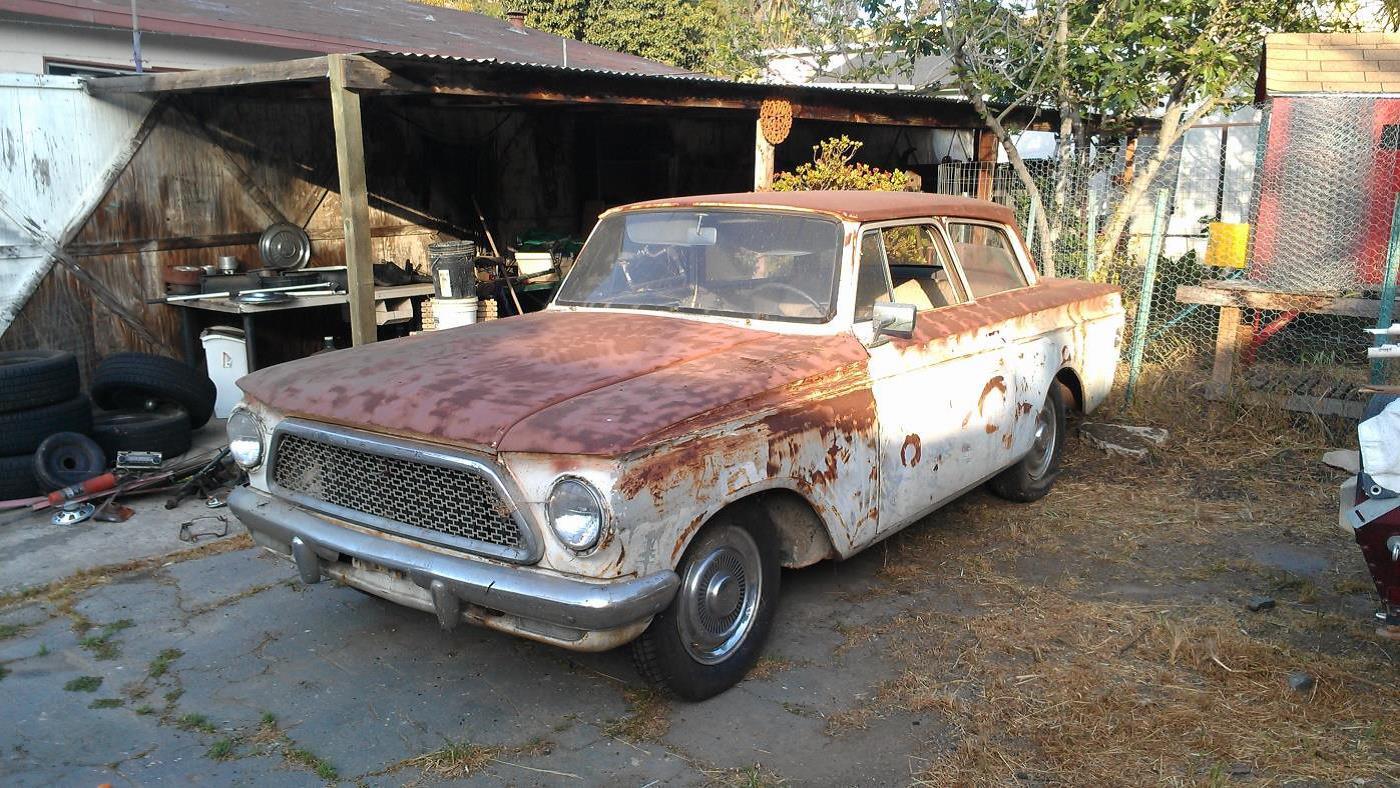


Tom Jennings work has been really interesting to follow and his ideas of wabi tek sabi have been a source of inspiration, informing an interest in the ways in which we interact with tools and how tools shape our interactions with the world.

“wabi tek sabi is a way of seeing and living with human craft and technology. like the japanese idea of wabi sabi it has much to do with aesthetics and pleasure, but it is mainly a way to look at, work with, and live with, technology.”

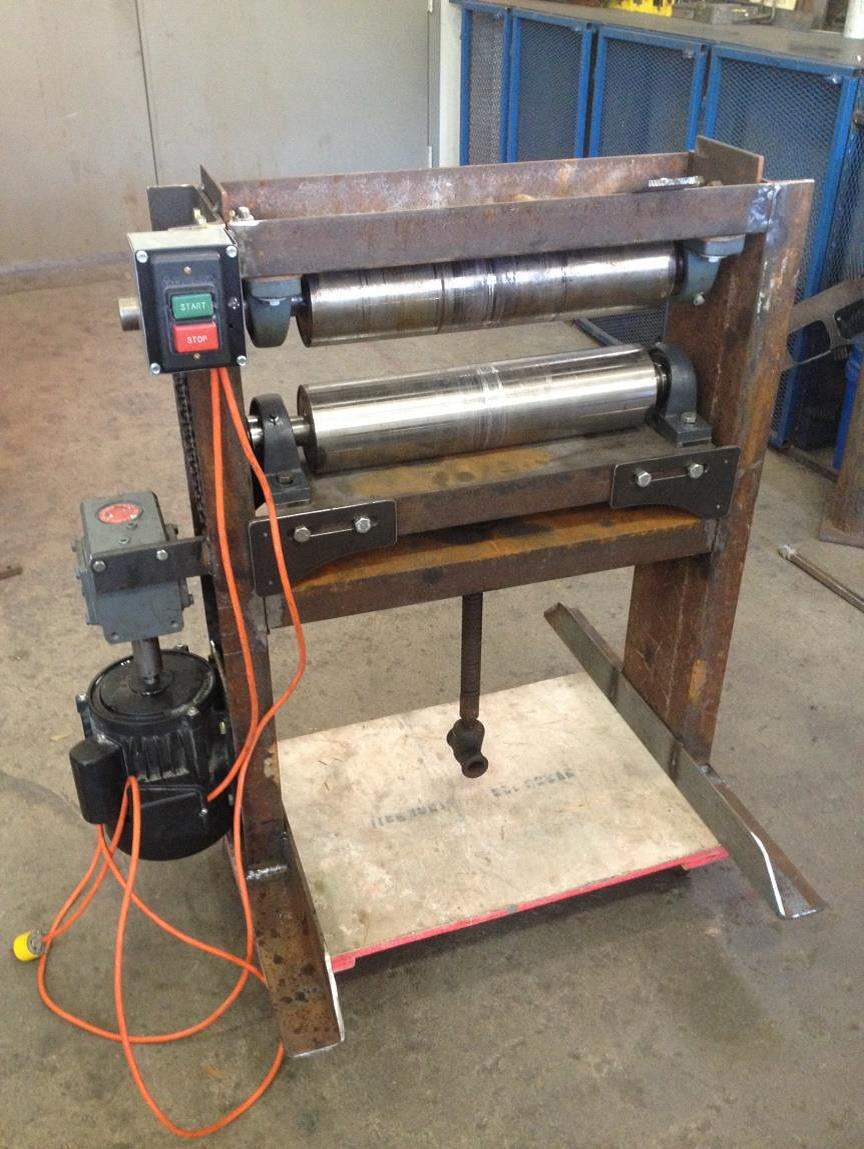
Tom Jenning’s work on his rambler roadster was an introduction to the world of hotrodding and led me to do more research into hotrod culture. Ideas on how to reduce weight were embodied in my design of a cast iron leg for the rolling mill I built earlier in the semester.

In my research into hot rod culture I came across the practice of drilling holes in into various parts of the cars in order to reduce weight. The shape of the circle allows the material to retain strength while greatly reducing the weight of the components.


More research on the possibility of forms that would allow me to merge aesthetic and function in an attempt to construct a leg that could support the press but wouldn’t increase the weight of the tool too much. I spotted the table at the Polich Tallix foundry, and the bench is one of many that line the streets of Louisville Kentucky.


The process of making the leg, following the images clockwise there is the making of the mold for casting, the divesting of the casting, the press before adding the leg, and the finished press after being painted.


Continuing with this idea of customizing tool and the construction of a shop I decided to create a swage block. The form of the swage block provided an excellent platform to create a custom tool. I chose to cast it in steel in the interest of increasing its resistance to shock, and included some fairly unique features like channels that could be used to dress various sizes of hexagons and faces that could be used to form funnels or tapered tubes, as well as various forms for creating different shapes of spoon and ladle. The swage block is a great form for the customization and personalization of tools and it’s an interesting object to boot. Clockwise there is the casting of my swage block, the milling of the faces in the CNC mill, and the finished swage block.


Work made during Junior Sculpture Foundry Fall '15 with Professor Coral Penelope Lambert

Tuesday, December 8, 2015

Of Dreams + Everyday Moments by Ava Carney

The void asks a question, protrusions provide an answer.

Protrusions can indicate growth --‐ regeneration --‐ evolution.

Protrusions can also indicate infection --‐ disease --‐ extinction.

Protrusions represent positive obsessions or negative obsessions.

Stage 1: Introduction to the Foundry : Five Objects
I began the semester by focusing on a specific interest. Humanoid creatures and animal hybrids are recurring subjects for me. These characters represent beings from my world. For my first project, I fabricated objects from this world.
Objects and beings appear in dreams or everyday moments.


I consider these objects to be models for larger works, especially the vessel. You might notice one piece to be missing from the series shown above. The absent sculpture is a spiky, lidded vessel --‐ it went home with a stranger while I wasn’t looking. Hopefully they will care for it.
This project was also my first time working with wax, ceramic shell, chasing tools, and the patination process. After making larger metal sculptures (i.e. Planet, Fruit--‐Sun),I would discover  that chasing on a small scale presents certain challenges. For tiny sculptures, mistakes in metal finishing are easier to make and harder to hide.
Stage 2: Expansion : Sand Molds, Feet Talismans, and Sun Being.
In my practice, sketches often serve as a starting point for sculptures. Sometimes, creatures drawn in improvisation take on greater significance upon extended reflection.
The head of Sun--‐Being is solid; occupying space with its all--‐encompassing mass. Protruding rays or antennae signify energy or growth. An empty hole for a body points to the void beyond: what lies past the radiant familiarity of a recognizable facial expression?

This creature was born in deep waters or dark space.
Dismembered feet are talismans to be multiplied for everyone on Earth. Maybe, they say: “think an evil thought every day.”
The butcher is in a sketchbook at my house.


During the creation of these mid--‐semester projects, I learned how to make one--‐part wax melt--‐out sand molds as well as a two--‐part sand molds.

Stage  3: The Big Idea: I want to go to space! and the Planet Fruit--‐Sun.


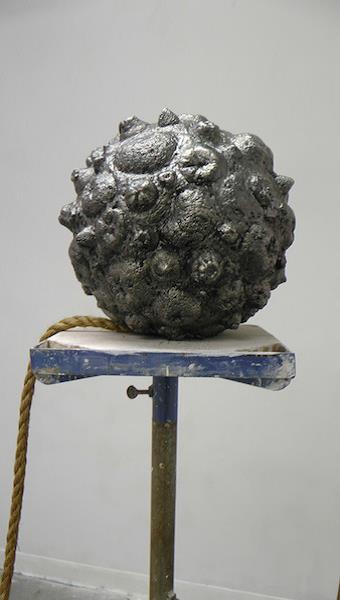
For my final project, I wanted to create a planet out of fruit. To do this, I cast wax in open--‐face plaster molds. During the process, I realized what mold making allows for is the sampling of textures and forms from the real world. By manipulating copies, I was able to obscure and re--‐contextualize what, at one time, was a familiar object. In Planet Fruit--‐Sun, the observable dimension collides with the dictates of my internal world, the familiar and the unknown merge, and the origins of the final product are concealed. Before this, I would usually point to the exterior world with referential forms. For example, my iron feet or bronze vessel, both shown in the pictures above.
In the creation of Planet Fruit--‐Sun, the size of the piece and amount of detail required in its surface challenged my wax working skills. I built the wax around a sand core and cast the sculpture in iron using the lost wax method.
 
Stage 4: Installation Explorations

The second half of my project – which was to cast a Stick--‐man and his Air--‐plane in metal --‐ it did not turn out the way I had anticipated.  I tried several times to cast Stick--‐man, but as I discovered, it is very difficult to sprue, vent, and cast thin, tiny and tall sculptures. I used this failure as an opportunity to explore other mediums.

If he were metal, Stick--‐man would have only appeared to be fragile, but in balsa--‐wood he becomes truly delicate (although maybe he doesn’t realize it?) Lustful for expansion, he wants to go to space in his air--‐ship.


Rope signifies the invisible communication occurring between Stick--‐man and Planet Fruit--‐Sun. She says, “don’t go to space, come to me, instead.”
At the end of the semester, when it came time to set--‐up for critique, I felt as though I had been stopped in the middle of my work--‐process. I used this circumstance as an opportunity for play. Carts lifted off the ground display my work: a depiction of my process stopped in time. Visual irony occurred as an intuitive by--‐product of the installation process, and enabled me to realize that humor can add layers to a situation.


In this additional collection of objects, I brought together a variety of work in different materials to observe what kind of scenario would emerge.

Fruit--‐comets sneak out of a moldy hole

Glo--‐worms emerge from the night’s sky and give each other kisses.

Over--‐growth is exciting, but I like to contain and arrange it.

Ava Carney, Sculpture Foundry, December 2015


Work made during Junior Sculpture Foundry Fall '15 with Professor Coral Penelope Lambert

NH4Fe (SO4)2, Cu (NO3)2, NH3 by Adrianna Enoch


I originally started out thinking about hiking, nature, and our impact on the environment. I was also interested in the idea of camouflaging the material in a way.


i Pieces by Berlinde de Bruyckere, Magdalena Abakanowicz and Romulo Celdran that I was influenced by initially.

As I was working through my ideas I started thinking about something temporary that would change over time. That led me to the idea of making a pipe and having a wax texture laid over it that would constantly change depending on the seasons and temperature outside. That kind of went with the idea that our environment is constantly changing as we keep walking on it and basically just keep living in it. I also started thinking about combining more industrial elements, like the pipes, with the more natural and textural elements and the dialogue between those two.


ii Original sketch of my idea


iii Wax and bronze pipes and textures I experimented with.

Then after looking at the patina test tiles I started getting interested in the different textures I could create with the waxes and how I could relate those textures to nature. I started with the textures I was playing with the first couple weeks and went from there. I started looking at different things in nature, like leaves, that I could either replicate the texture or just press it into the wax.


iv Textures I cast out of iron and aluminum and reference photos of lichen.

I got really interested in the patinas and the different chemicals used. My idea changed into more of a science project. I wanted to display tiles with different textures and patinas in the same way they are put on the wall in the foundry. I wanted to add a written element that said what chemicals were used and what each texture was. I wanted the piece to be more about the process and showing that process at that point.


v Sketch of new idea for installation.

I was also thinking about moving the piece off the wall and onto a sidewalk that people would walk on, so that it would change constantly, which kind of goes back to the idea of the piece being something that is temporary.


vi Reference photos for brick and tile patterns.

I began to think of these tiles as more of a growth than a science experiment and was trying to think of ways to install them that would reflect that. This made me think of the idea to install the tiles on the wall and have them flow onto the floor so that they come off as growth or lichen that would grow naturally in the woods or on a building. I had all of it planned out for install, but then I cut my thumb and realized it was going to be too big of an installation process to do in a week with stitches so I started thinking of other ways to install.


i Reference photo and sketch of growth idea.

I started looking at Cornelia Parker and hanging sculpture in general and was interested in the types of shadows that could be achieved and how immersive the hanging pieces could be.


viii Piece by Cornelia Parker.

For install I hung the tiles randomly, not too low, but not too high. I wanted you to be able to see every tile close to eye level but not exactly at eye level so that you still have to interact In some way. The idea was to hang them in a way that was reminiscent of leaves falling. The piece is basically what hiking feels like for me. The woods are very immersive and full of all these colors that are kind of like rust and more industrial colors. I think of industrial colors as dark browns, blacks, reds, and oranges. Like the woods, the piece is immersive and all over the place in a way, but not intimidating.


ix Install photos.

I think the end piece is interesting to me when I consider my process because I was getting further away from my original interest and then by the end of it I had made my way back to the original idea. I think the end piece speaks to my interest in our influence on our environment. It has an industrial feel to it because of the rust on the tiles and the fact that the tiles are metal. The tiles also have the temporary feel to them because the surfaces are going to keep rusting over time and will keep changing because I didn’t seal them with wax. The tiles are temporary because the surfaces are changing constantly, but at the same time metal is not seen as a temporary material. Metal is used for structure, stability, and permanence usually. I want to keep exploring this piece by hanging the tiles in different ways that create new shadows and different ways to interact with the piece. I also want to possibly make more tiles and make more immersive spaces.


Work made during Junior Sculpture Foundry Fall '15 with Professor Coral Penelope Lambert